rotarycb1934@gmail.com
+91 80 2212 0317
Rotary House of Friendship 20, Lavelle road, Bengaluru
Don’t miss it!
Happy reading!
Your Rotator Team 2024–25
Leopards in the Backyard: Bengaluru’s Wild Secret Revealed
 When we think of wildlife, images of tigers and elephants in the wild often spring to mind. But for Dr Sanjay Gubbi, renowned wildlife biologist, wildlife isn’t restricted to remote jungles or iconic national parks — it includes butterflies, beetles, mushrooms and even the silent leopard prowling at the edge of India’s bustling IT capital.
In his captivating talk titled “Bangalore – India’s New Leopard Capital”, delivered at the 52nd meeting of RCB, Dr Gubbi shed light on the surprisingly rich biodiversity in and around Bengaluru and stressed the urgent need for conservation.
Scientific estimates suggest that around 80 to 85 leopards roam the peripheries of Bengaluru, with approximately 55 of them inhabiting Bannerghatta National Park alone. “Bangalore is the only metropolitan city in the world where large mammals such as elephants, leopards, and wild dogs still survive in the wild,” Dr Gubbi noted. “It’s something we must take pride in — and protect.”
While tigers and elephants steal the spotlight, Dr Gubbi reminded the audience that wildlife includes a vast range of flora and fauna—birds, reptiles, insects, fungi and trees—each playing a vital role in maintaining ecological balance.
For instance, the hornbill, a fruit-eating bird, helps in seed dispersal by excreting seeds far from the parent tree, allowing fig trees to grow in new locations. Elephants too are inadvertent gardeners—plants sprout from their dung piles, which also nourish the soil and feed insects such as dung beetles. Even butterflies are drawn to animal droppings, extracting essential salts and minerals.
Through camera traps and scientific data, forest departments track the unique stripe patterns of tigers—each as distinctive as a human fingerprint—illustrating how modern Science supports wildlife monitoring and protection.
Dr Gubbi emphasised the importance of involving local communities in conservation. In the Cauvery Wildlife Sanctuary region, for example, forest-dwelling families have been given LPG cylinders and fuel-efficient heaters to reduce firewood dependence—leading to a 90 per cent drop in firewood use, decreased carbon emissions, and improved health outcomes, including a fall in respiratory diseases.
Additionally, solar-powered lighting has been introduced to reduce human-wildlife conflict, while enabling children to study after dark. “Conservation is not just about protecting animals,” he stressed. “It’s about supporting people too.”
Dr Gubbi concluded with a sobering reminder: Bengaluru’s water is not sourced from the much-debated Mekedatu project but from the Cauvery Wildlife Sanctuary. Protecting this forest ecosystem, therefore, isn’t just an environmental cause—it’s a matter of urban survival.
“Wildlife conservation isn’t a luxury; it’s a necessity,” Dr Gubbi said. “And Bangalore, with Its unique blend of biodiversity and urban sprawl has both the challenge and the opportunity to lead the way.”
Smart Classrooms, Smarter Futures
Technology for Our Schools
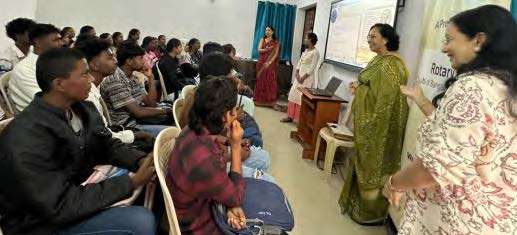 Rotary has always played a vital role in strengthening the physical and academic foundations of government schools by building better infrastructure and enabling teachers to deliver more impactful lessons. Now, in another step forward, RCB is also helping bridge the digital divide by bringing technology directly into the classroom.
Thanks to the efforts of the International Service Committee and matching support from RCBCT, ten smartboards and curriculum-enabled smart TVs have been installed in the following schools:
Concerns India School, Hanke Bruna School, Govt. High School Devallapura, Govt. Higher Primary Schools in S. Gollahalli and Chamrajapete (both in Chikkaballapur). These teaching aids are transformational tools, allowing teachers to deliver lessons with visual content, animations, and real-time interaction, making concepts easier to grasp. For students, learning becomes more engaging, intuitive, and collaborative.
For most of these students, this is their first exposure to digital education, a window to a larger world of knowledge and opportunity. Kudos to President Gowri, Director of International Service Dr. Mustali Vagh, and Rtn. Sagarika Ghosal for their swift execution of this project, well in time to mark the close of RCB’s landmark 90th year.
Spelling Bee at RCB: A Remarkable Display of Talent!

On June 22nd, the RCB’s Youth Services hosted a Spelling Bee Contest. The event brought together 145 children from 18 schools, across classes 4, 5, and 6. From the (written test) qualifiers, 15 talented semifinalists emerged to compete in the oral spelling round. Guided by pronouncer Rtn. Vijay Rao, participants tackled a variety of challenging words with remarkable poise. After a series of spelling rotations and eliminations, six finalists advanced to the finals. A tense tiebreaker determined the first and second runners-up before the winner was crowned.
The victorious students
1. Aarav Vijay Girish, Daffodils Foundation
For Learning;
2 Aryamann Gaine, Bishop Cotton Boys
School:
3. Keshav Ramanarayana Krishnadev, New
Horizon Public School
were given prizes by President Rtn. Gowri Oza and Rtn. Srini Velidanda, Director, Youth Services.
All 145 students received a Certification of Participation and the winner and runners up received Gift Vouchers from Sapna Book House, graciously sponsored by Rtn. Nitin Shah.
Special thanks to event champion Dr Nita Roy and judges Rtns. Shailesh Rudra, Dr. Anju Agadi, Sandeep S. and Rtrs. Andrew Simon and Krishnaarjun. A callout to Rtn. Sneha Naidu, Rtn. Ganesh Venkataraman and Ann. Kalpana Ganesh for their time and expertise.
The Spelling Bee was more than a contest; it was a celebration of knowledge, teamwork, and the enduring power of words.
-Rtn. Medha Rao
The Flagship Solarization of PHCs Project
The Rotary Club’s flagship initiative for the year — Solarization of Primary Health Centres (PHCs) in Rural Karnataka — has reached an impressive milestone.
As of 30th June 2025, solar energy systems have been successfully installed in 45 PHCs, ensuring uninterrupted power supply, especially in labour rooms where dependable electricity can make a lifesaving difference.
This ambitious project was made possible through generous donations of ₹1.25 lakhs per centre, with SELCO as our key implementation partner. SELCO’s subsidized solar solutions helped bring reliable, green energy to underserved health centres. The broader goal was to solarize 100 PHCs in 5-6 districts in the state — strengthening maternal and child healthcare, improving service reliability, and building climate-resilient healthcare infrastructure. By reducing power outages, we’re enabling doctors and nurses to deliver care with confidence, day and night.
With funding now secured for 88 PHCs, it is now a matter of 2-3 months by when the remaining 43 centres will be solarized, extending the impact to many more communities in need.
This project is not just about electrification — it’s about empowerment, dignity, and sustainable transformation in rural healthcare. As the Rotary year closes, this is an apt time to once again recognize the commitment of President Rtn. Gowri and tireless efforts of PP Rtn. Ranga Rao, Rtn. Manjunath A. N. and Director Community Service Rtn. Kavita Muthappa for bringing the project thus far.
A Proud Moment for RCB: Rtn. Elizabeth Cherian installed as District Governor
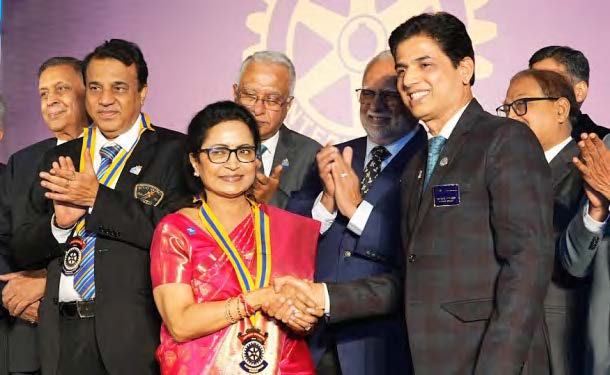
It was a moment of immense pride for the Rotary Club of Bangalore as Rtn. Elizabeth Cherian was installed as the District Governor of Rotary District 3192
— The first RCBian to hold this office in 20 years. Her elevation is not only a personal milestone but also a great honour for our club, and a recognition of RCB’s deep-rooted legacy of leadership and service. At a gala ceremony held at the Taj Yeshwantpur on June 29th, 2025, she was installed by RID Rtn. K. P. Nagesh, with PRID Rtn. Manoj Desai, being the Chief Guest.
The event was attended by over 500 Rotarians from all clubs, several district officials and friends, including more than a hundred from RCB who turned out in full strength to support and celebrate one of our own. It was an evening marked by warmth, energy, and the quiet satisfaction of seeing history being made.
In a poised and powerful address, DG Elizabeth acknowledged the strong foundation laid by her predecessors and emphasized her vision for the year ahead. She expressed her intent to run district projects primarily through the clubs, thereby empowering them and strengthening grassroots impact.
Among her focus areas are animal welfare, wellness, and mental well-being of Rotarians, and encouraging Kannada familiarity within the Rotary community — an inclusive touch rooted in regional pride.
On June 30th, when she made her first official visit to RCB after taking office, she was received with a traditional and heartfelt welcome. Speaking with visible emotion, she recalled her journey within the club and the enduring values she imbibed here — values she now carries with her as she leads the entire district.
District 3192, with its 93 vibrant clubs, is in capable hands. And for RCB, this year is extra special — for our own is at the helm.