rotarycb1934@gmail.com
+91 80 2212 0317
Rotary House of Friendship 20, Lavelle road, Bengaluru
Happy reading!
Your Rotator Team 2025–26
PROJECT OF THE YEAR SMART BOARDS AND BENCHES

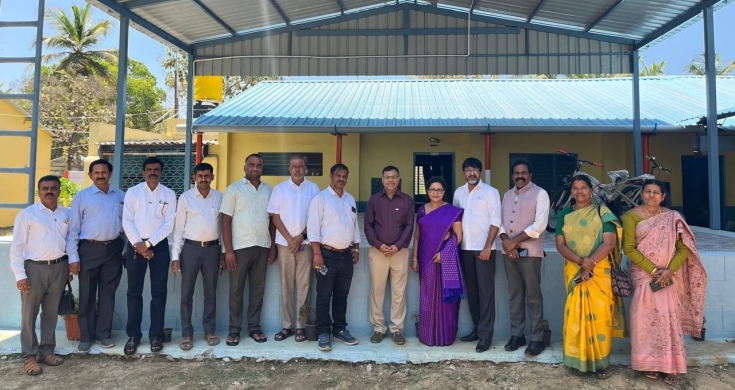

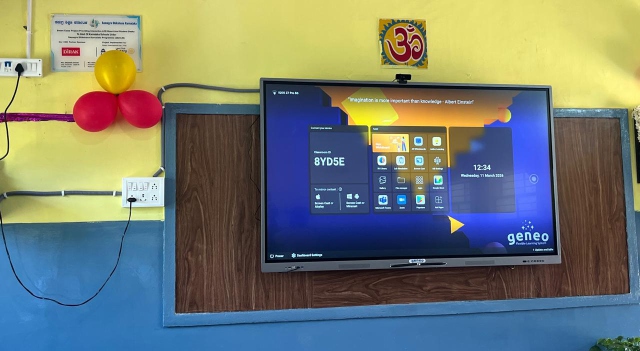
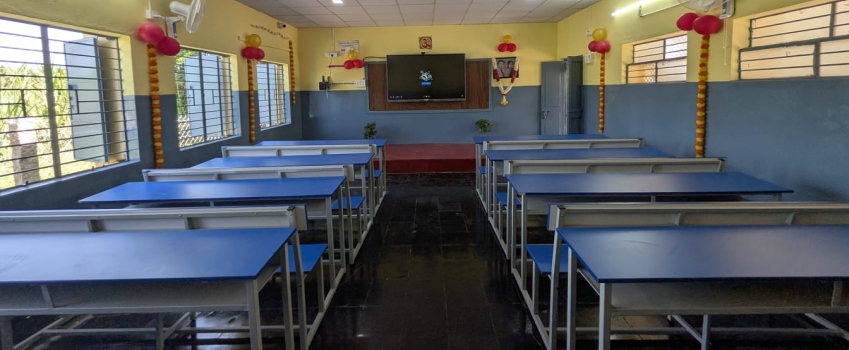
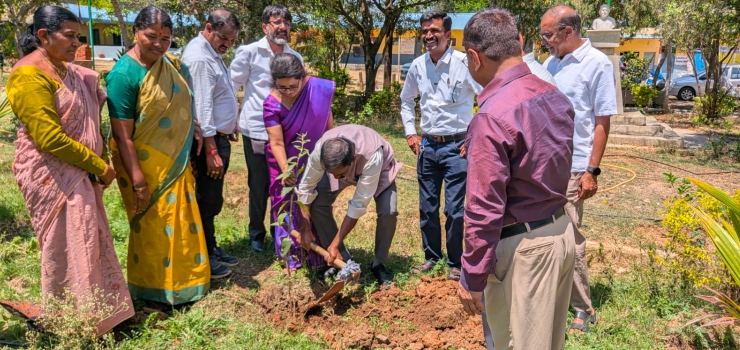
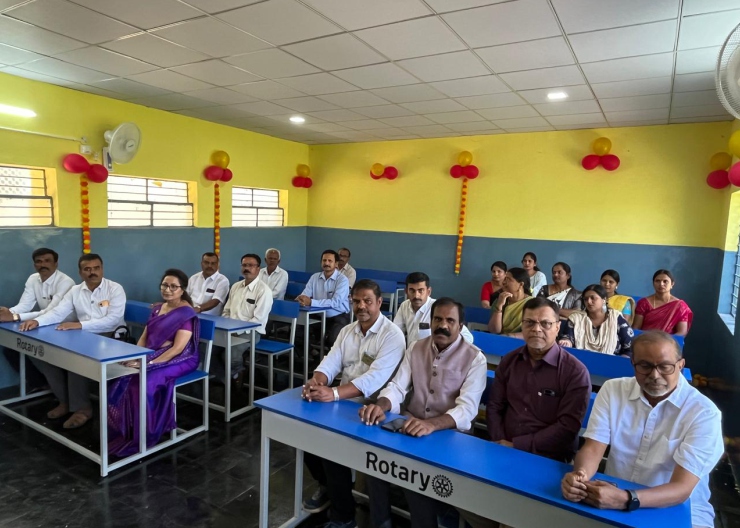
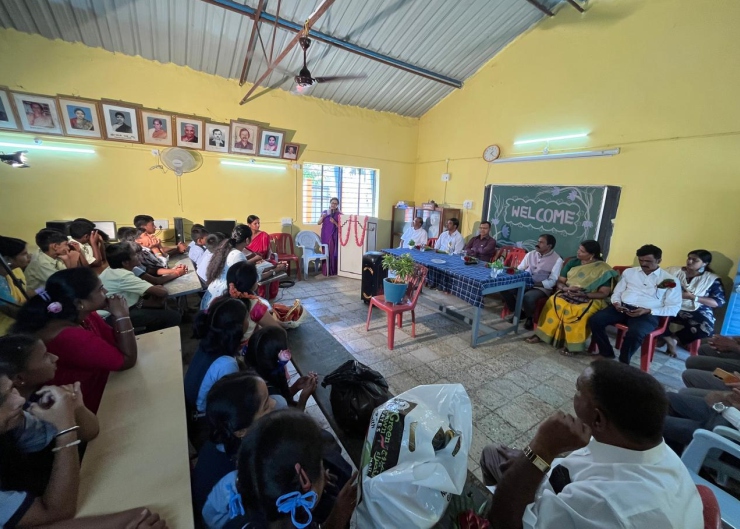
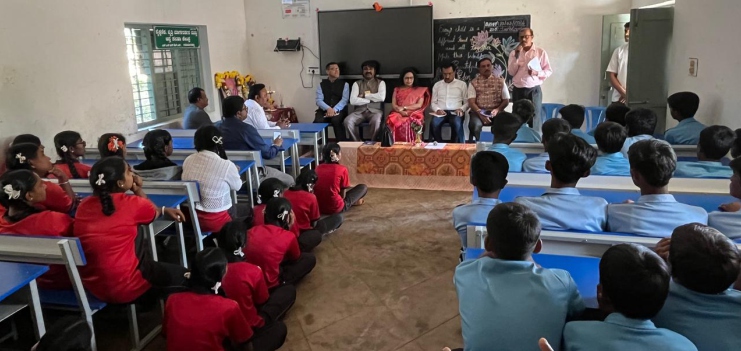
In a significant step towards enhancing digital learning in rural areas, smart boards were installed in two government schools, bringing modern educational tools closer to students who need them the most. This initiative reflects a strong commitment to bridging the gap between urban and rural education systems through technology-driven solutions.
The project was implemented in Sri Siddaganga Rural High School, located in Gudemaranahalli village (Magadi Taluk, presently under Nelamangala Taluk, Bengaluru Rural District), and a government school in Valagerehalli, Maddur Taluk. Both institutions cater to students from rural backgrounds, where access to advanced learning resources is often limited.
The smart classroom installations were done through the CSR support by DIRAK INDIA represented by Rtn Dileep Pillai, who ensured seamless setup and functionality of the digital infrastructure. These projects were done in association with Rotary clubs of Nelamangala and Maddur.
The total cost of the project was ₹5 lakh, covering procurement, installation, and initial setup.
Both smart classrooms were formally inaugurated by the District Governor Rtn Elizabeth Cherian along with members of Rotary Club of Nelamangala and Rotary Club of Maddur and Rtns Dileep Pillai and Anand Bindagi. The inauguration ceremonies were met with enthusiasm from students, teachers, and the local community, who recognized the value of this initiative.
By introducing smart classrooms in these two schools, the initiative has laid the foundation for a more engaging, inclusive, and future-ready learning. It directly impacts students, teachers, families and the entire communities.
-Rtn. Anand Bindagi
RBV Educational Trip to IISc-0pen Day.

On 7th March, 2026, 140 students of classes 6, 7, 8 & 9th standards were taken for the IISC Open Day along with 6 teachers. They left school in 3 buses at 8:00AM. The students were very excited as it was their first trip to IISC and they were awestruck to see the huge campus.
They visited the Departments of Biological Sciences, Microbiology, Physics and Aerospace. The children were also taken to the Kid Zone where school level science experiments were demonstrated by IISc students of various departments. There were hands on experiments and small prizes to be won. The children thoroughly enjoyed this event and their curiosity was piqued. Lunch was served in a park where they relaxed for a while before proceeding further. By 5:30 PM, they reached back to the school. Rotarians Dr. Maneesh Paul and Sapna Paul visited the students at IISc and interacted with the students.
-Rtn. Sapna Paul
The Self-Appointed Mayor of Public Spaces
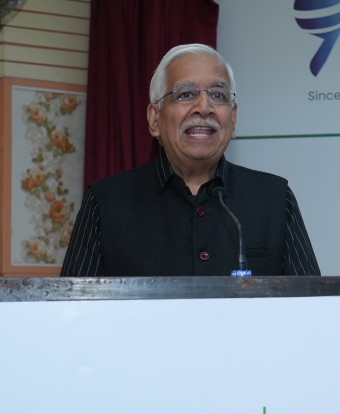
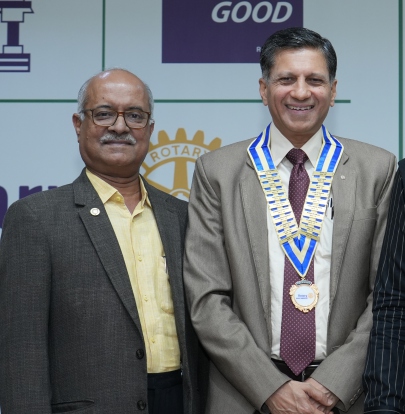
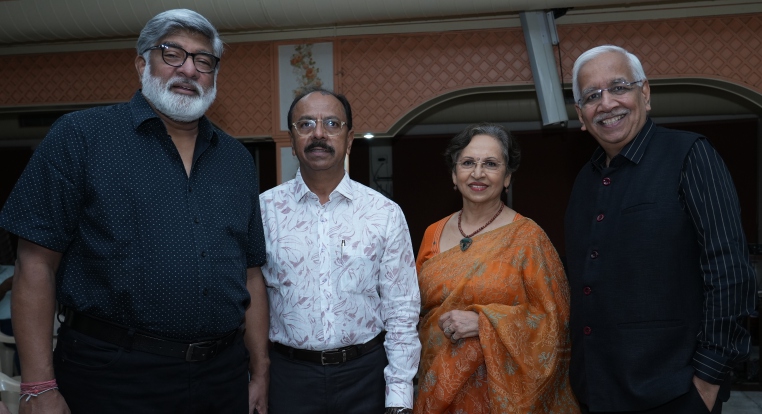
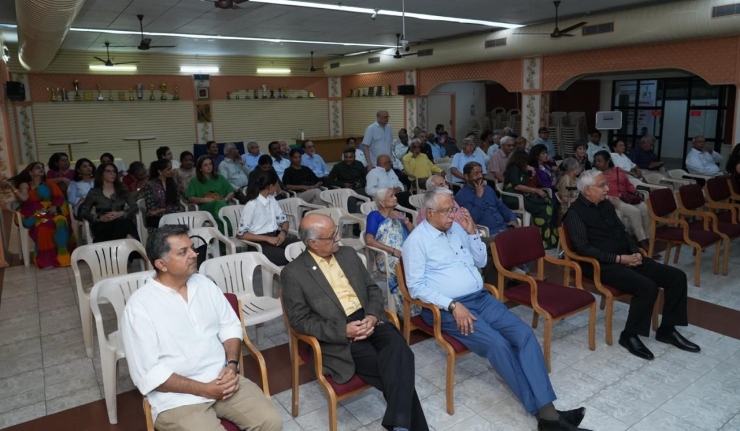
In Bengaluru, a city that hums with the restless rhythm of traffic and the quiet glow of screens, there exists a man who calls himself the “self-appointed mayor of public spaces.” Mr. V. Ravichandar is not a politician, nor does he hold office. Yet, in the minds of many, he has become an urban legend —an advocate for the soul of the city.
Our guest speaker last Monday, Mr. Ravichandar, spoke with words that carried the weight of conviction, but also the warmth of someone who believes deeply in human connection.
“Public spaces,” he began, “are not just patches of land or concrete courtyards. They are the essence of what it means to be human.
They are places where we ask questions, where we talk to strangers, and where friendships are born.”
He spoke of a future where people would crave spaces to detach from their digital lives—to rediscover the joy of conversation, laughter, and shared silence.
Mr. Ravichandar’s philosophy was not limited to parks or plazas. He believed that buildings themselves could become magnets for the community.
“A building,” he said, “must be marinated in thought. Its design should not be rushed. It should be crafted so carefully that, when it stands, it draws people towards it like a magnet.”
He painted a picture of architecture that was alive—walls that breathed, corridors that invited, and courtyards that whispered stories. To him, a building was not just a structure; it was a living wall where people could immerse themselves, exchange ideas, and feel part of something larger. But he was practical too. “A building must sustain itself,” he reminded the Rotarians.
“It must be monetised—not for profit alone, but for sustenance, for longevity, and for the ability to keep serving the community.”
To build was not merely to construct; it was to take responsibility.
“When you plan a building,” he said, “think of how people will consume the spaces within it. Think of sustainability. Think of carbon footprints. Every brick, every beam, every light switch carries a responsibility to the planet.”
He urged architects and planners to imagine multi-use structures—spaces that could host a lecture in the morning, a concert in the evening, and a quiet gathering of friends at night.
Flexibility, he believed, was the heartbeat of a true public space.
To ground his vision, Mr. Ravichandar pointed to two Bengaluru landmarks: the Bangalore International Centre and Sabha. These, he said, were magnets—places where people from different walks of life converged, not because they had to, but because they wanted to. They were proof that when spaces are designed with thought, they become more than buildings; they become communities.
At the Bangalore International Centre, one could find scholars debating policy, artists unveiling new works, and citizens simply enjoying the atmosphere. Sabha, with its layered design, invited performances, discussions, and casual encounters. Both spaces embodied the principle that architecture could nurture dialogue.
His words carried the cadence of a storyteller, weaving metaphors of magnets, living walls, and marinated plans.
When the evening ended, the Rotarians left with a vision—a call to reimagine the proposed new building. Mr. Ravichandar, the self-appointed mayor, had once again reminded them that public spaces are not luxuries, but necessities.
And so, in Bengaluru, his legend grows. In every corner where people gather, his vision lives on—a reminder that to be human is to belong, and to belong is to share space.
Wishes do come true : Gift a Blanket initiative and Adult Diapers
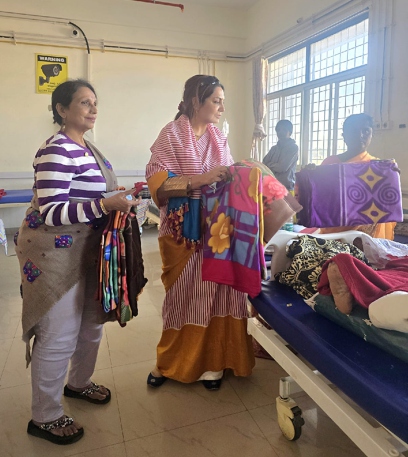
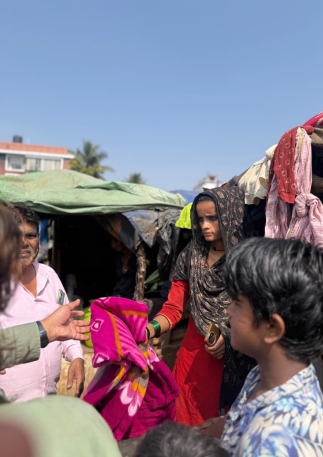
With the generous support of Rtn. Minku B, Rtn. Gertrude, and Rtn. Nita Roy, and the active participation of Rotaract Falcon and Smile Seva Kendra, a successful distribution drive was carried out for underserved communities.
A total of 550 blankets and 120 adult diapers were distributed to:
• 100 beneficiaries at Bowring Hospital (patients & relatives)
• 350 residents of JP Nagar slum settlements
• 100 residents at Maria Nivas, Chikkanagamangala
Project Cost:
• Blankets: ₹64,000 847,231 supported by Rotary; balance raised by Rtn. Minku)
• Diapers: ₹4,464 (donated by Rtn. Minku & Rtn. Gertrude)
A simple yet powerful initiative—bringing warmth, care, and dignity to those who need it most.
– Rtn. Minku Buttar
