rotarycb1934@gmail.com
+91 80 2212 0317
Rotary House of Friendship 20, Lavelle road, Bengaluru
Happy reading!
Your Rotator Team 2025–26
The Clever Plan
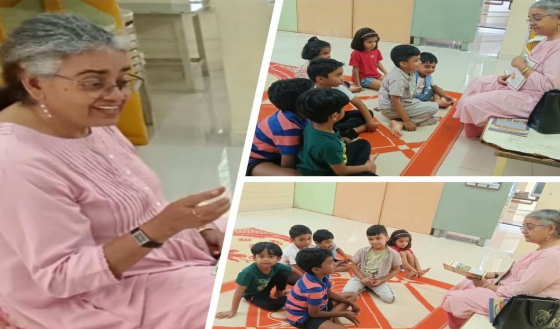
On Saturday, 29th August, RAGES in association with WWF for Nature Karnataka conducted the first walk in Lalbagh Botanical Garden.30 students of RBV School arrived early in the morning and were taken on a guided Nature appreciation walk for two hours by reputed naturalist Mr. J.N.Prasad. Varieties of birds like barbets, owls, kites, etc were spotted, and their unique behaviour was explained by the naturalist. Myriad plants, trees and insects were identified, and the children of our school along with the Rotarians present had a unique morning. The project ended with breakfast amongst the members of RAGES.
-Rtn Jayanth Rudra
ShieldAll 69th Session: Empowering Young Minds Against HPV-Related Cancers
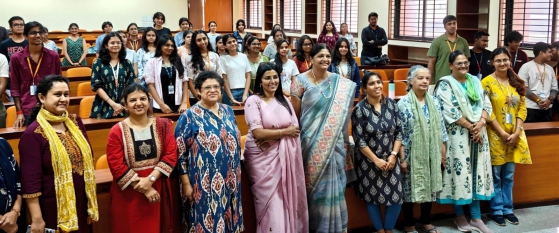
The 69th awareness session of ShieldAll: United Against HPV-Related Cancers was conducted at PES University, Banashankari, Bengaluru, on September 2, 2026, featuring Dr.Shobha K., Professor & Unit Head, Gynaecologic Oncology, Kidwai Memorial Institute of Oncology.
The session brought together 70 B. Tech Biotechnology students and 10 staff members for an engaging discussion on HPV-related cancers, prevention, and the importance of early detection. The interactive Q&A session saw enthusiastic participation from both boys and girls, reflecting growing interest in gender-inclusive HPV awareness.
We sincerely thank the PES University management, especially Dr. Reshma, HOD, Department of Biotechnology, and Dr. Kavitha for their excellent coordination and support in making the session a success.
– Rtns. Dr. Sowmya P. R & Dr. Nita Roy.
Creating Stories, Building Careers: RCB’s Emerging Careers Initiative
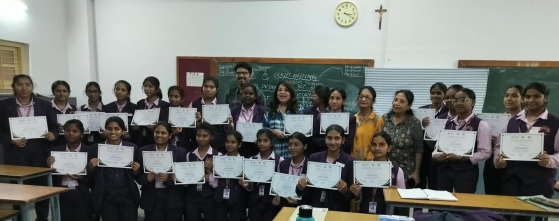
ARCB’s Vocational Service initiative, “Emerging Careers Behind the Camera,” successfully completed its three-day training in Script Writing & Storytelling at St. Anne’s Girls Pre-University School on September 2nd and 3rd, led by filmmaker and creative storyteller Mr. Islahuddin.
The second session engaged 30 students (6 man-hours) and the third 35 students (12 man-hours).
Students enthusiastically participated and created 20 well-written stories, with Romance being the most popular theme, followed by Cultural, Psycho-Thriller and Adventure stories.
The initiative empowers economically challenged young women with creative and technical skills, opening pathways to careers behind the camera. Amount spent: 10,000 towards the teacher’s professional fee.
— Team Emerging Careers Behind the Camera
OFF THE CUFF When Rotary Turned Me into a Chef!
It all started maybe around ten years ago. At our Rotary Club, someone got the idea of a ‘Men’s Cook-out Nite’. •Those of us men who dared to participate were expected to dish out at least one item. Stalls would be set up, and we could showcase our culinary talents on that eve.
I, for one, who had absolutely no • previous experience in cooking, was in a dilemma as to my participation. I had the urge to learn a new skill… now, how to start? Where and when? I turned to my multi-talented wife, looking for a solution. As always, she amazingly never disappoints me. She assured me that she would teach and guide me and that I should accept the challenge.
So, the process started with the selection of the dish…could range from Soups, Salads, Italian bruschettas, Pita bread with hummus, Pizza, Chaats, or traditional Shavige with Kaihalu, variety of Chocolates, Desserts such as Puddings, Brownies.
Usually, the event happens on a Monday evening and therefore, logically, the preparations begin over the previous weekend. It starts with the shopping for the various ingredients, keeping in mind that we need to cater to 100-150 people! If the budget becomes huge, then I would rope in a few friends into the team to share/pool the resources. The actual process of the cooking/ baking is an amazing art/science..Step by step, I would learn to do it the right way.
My experiments were joyfully rewarded when people would appreciate the dishes the next day at the event. The satisfaction I would derive from going through this exercise was in watching the people enjoy the dishes and coming back for more..Usually, I had enough for everyone.
-Rtn Shailesh Rudra
Ryla & School Bags Distribution
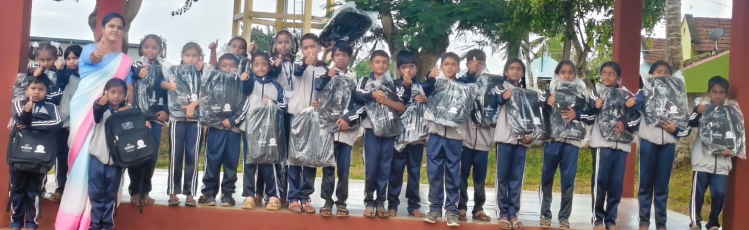
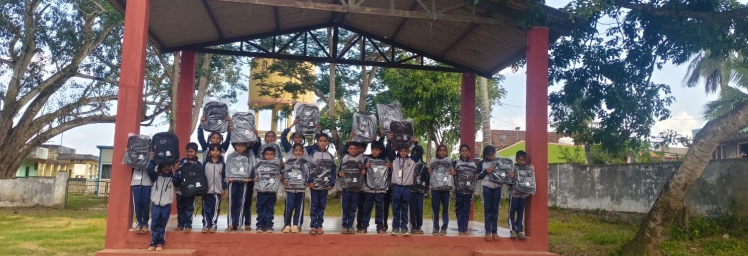
On behalf of Rotary Club of Bangalore, Rotary Club of Suvarna Bengaluru, and eTeachlndia, we conducted a RYLA (Rotary Youth Leadership Awards) programme for the young students of the school at Kharapura, near Kabini on Sept 7.
The programme was designed to nurture confidence, leadership, and holistic development among the children through engaging sessions on Table Tennis, Confidence Building, Public Speaking, and Yoga.
During the programme, the school teacher made a request for school bags for the students. With the generous support of the Rotary Club of Bangalore, we were delighted to fulfil this request and distribute school bags to the children.
Small gestures can create big smiles — and sometimes, a school bag carries much more than books; it carries hope, confidence, and a little more excitement for school,
PP Rtr Krishnarjun
Charter Night
The charter of Rotary International was presented to the Rotary Club of Bangalore on October 27, 1934. It was Rtn. H. W.Bryant of the Rotary Club of Bombay and Honorary Commissioner for Afghanistan, Burma, Ceylon, and India, who represented Rotary International and handed over the Charter. This historic meeting was held at the West End Hotel in a hall resplendent with Rotary motifs, the walls draped with International flags and the Rotary Wheel. The meeting was preceded by dinner.
Hon. Lt-Col. C.T.C. Plowden, British Resident in Mysore, graced the occasion and proposed toasts to His Majesty, the King Emperor and His Highness, the Maharaja of Mysore.
The sponsor club, the Rotary Club of Madras, sent th ree emissaries – Rtn. Jackson, Rtn. Money and Rtn. Luker.
Presenting the Charter, Rtn. Bryant felicitated the Bangalore Club on the rapid progress already made in that short span of five months.
He remarked that the decorations on the menu card were evidence of the wall that evening and the very fine enthusiasm with which the Club was working.
Rtn. Bryant emphasized that in all Rotary activities, it was essential not to be in too much of a hurry. Each individual should fully imbibe the spirit of Rotary. It is through the efforts of these individuals rather than those of the group that the objects of Rotary could be fully realised. He stressed the importance of ‘service’ and said that the Community Service Committee was the ‘real pivot’ of the Club.
Describing Bangalore and its surroundings as a promising field for service projects, Rtn. Bryant exhorted the members to interpret and apply the word ‘service’ in its fullest and widest sense.
He then presented the Charter and conveyed the good wishes and congratulations of R.I.President Hill, of the Rotary Club of Chicago, and the other officers of Rotary International.
Rtn. Pres. McIver assured Rtn. Bryant and the officials of Rotary International, that “it would be the endeavour of each and every member of the Rotary Club of Bangalore to do his best to promote the aims and objects of the Rotary movement.
“In the past five months, they have laid a ‘strong foundation for the future growth of Rotarian endeavour in the station and in the city. ” He expressed appreciation of the efforts of Secretary Munro of the Rotary Club of Bangalore and Rtn. Jackson of the Rotary Club of Madras, and thanked the latter for the invaluable advice he had given at the inaugural meeting.
Rtn. B.G. Rajagopala Mudaliar proposed a toast to all the sister clubs in India and thanked them for their help and goodwill. He expressed gratitude in particular to the Rotary Club of Madras, for its staunch support and encouragement.
Rtn. Jackson suggested close association between the Madras and Bangalore Clubs, and proposed joint meetings at least once in two months. After toasts to the guests and the members present, there was an improm ptu concert, in which all the Rota rians present participated.
It is of interest to record that Rtn. Herbert W.Bryant, who presented the Charter, settled down in Bangalore on his retirement from professional activities in Bombay. For about a decade, till his death in June 1960, he was a member of the Rotary Club of Bangalore and took keen interest in its activities. Senior members would recall with gratitude, the friendliness, and the guidance of this erudite Rotarian.
-PP. Rtn.Purnima Ranganath
GOLD, OIL & THE RUPEE The Economic Trinity Shaping India’s Future
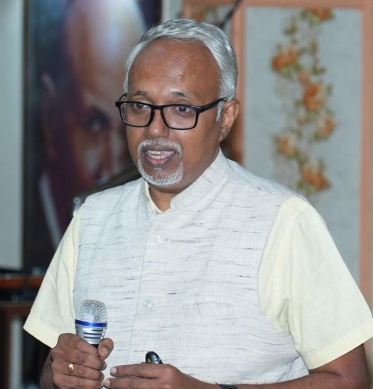
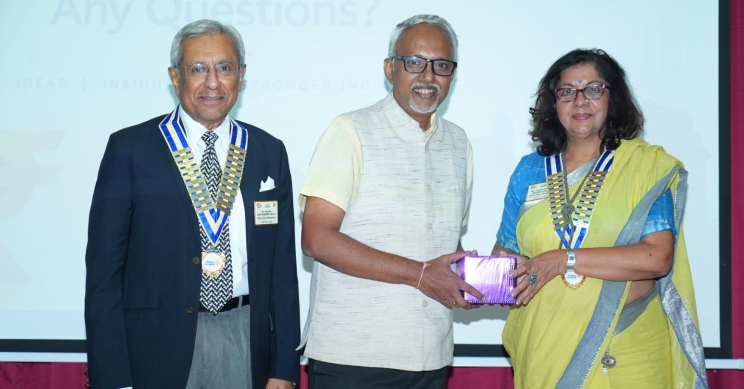
The Monday meeting at the Rotary House of Friendship was unlike any other. It was not a gathering for entertainment, music, or dance, nor a casual evening of camaraderie. It was, in fact, the last such meeting to be held at the venerable RHF, and the occasion carried with it a sense of solemnity and reflection. Rotarians and guests assembled not to celebrate, but to deliberate on three pillars that shape India’s economic destiny: Gold, Oil, and the Rupee.
The speaker for the evening, Mr. Venkitesh lyer – a seasoned banker turned educator and finance expert – took the audience through a meticulous dissection of these three elements. His thesis was simple yet profound: Gold, Oil, and the Rupee are not merely commodities or instruments of trade; they are India’s economic opportunity. Each, he argued, has a unique place in the nation’s story. Gold belongs to households, Oil keeps the country moving, and the Rupee rests in the pockets of the people.
Together, they form a trinity that influences both personal wealth and national prosperity.
Gold: The Darling Metal of Indian Households
Mr. lyer began with gold, the yellow metal that has captivated Indian households for centuries. He threw a challenge to the audience: “Is there a single household in India that does not possess gold?” The answer, of course, was rhetorical. From urban apartments to rural hamlets, gold is woven into the fabric of Indian life – be it in the form of ornaments, heirlooms, or investments.
Yet, Mr. lyer’s critique was sharp. While gold has appreciated in value over the years, multiplying several-fold, it remains largely a dead investment. Locked away in bank vaults and household lockers, it does not contribute to the productive economy. “Has this appreciation in value translated into the growth of the country’s economy?” he asked pointedly. The silence in the room was telling.
India imports over 800 tonnes of gold annually, draining precious foreign exchange reserves. The emotional attachment to gold, he noted, blinds households to its economic inefficiency. While it serves as a hedge against inflation and a saviour in uncertain times, it does little to fuel growth. “Gold outperforms during crises,” he conceded, “but from an economic perspective, accumulating gold is not the right thing.” The paradox of gold – beloved yet economically burdensome – was laid bare.
Oil: The Liquid Gold That Powers Nations
From the glitter of gold, Mr. lyer moved to oil – the “liquid gold” that powers economies. Oil, he reminded the audience, is indispensable. Without it, a nation’s economy grinds to a halt. For India, however, oil is a double-edged sword. Nearly 85% of the country’s crude oil is imported, once again consuming vast amounts of foreign exchange.
Oil prices, he explained, are subject to the vagaries of geopolitics. A crisis in West Asia, a disruption in supply chains, or even deficit rainfall in India can send prices soaring, triggering cost-push inflation that hurts the poorest the most. The dependency on oil makes India vulnerable, and the volatility of global markets ensures that the burden is cyclical.
Mr. lyer illustrated this with figures: in 2013, India’s oil import bill was 8.8% of GDR By FY 2015—16, it had fallen to 3.9%, only to rise again to 6.3% in FY 2022—23, before moderating to 5.1% in FY 2023—24. “This burden,” he said, “is cyclical, and crude prices matter. It is difficult to control the price movement of this commodity as it is controlled by a cartel. Oil is a cartelised commodity.”
Yet, there was hope. He pointed to India’s push towards renewable energy – solar initiatives, electric vehicles, and alternative fuels – as steps in the right direction. These, he said, are not just environmental imperatives but economic necessities to reduce dependence on imported oil.
The Rupee: Vulnerable Yet Vital
The third element of Mr. lyer’s trinity was the Rupee, India’s currency and symbol of sovereignty. The Rupee, he explained, is deeply intertwined with oil. Every barrel of crude imported requires dollars, and the conversion of Rupees into greenbacks places constant pressure on India’s foreign exchange reserves. The more oil India imports, the greater the demand for dollars, and the more vulnerable the Rupee becomes to fluctuations.
This vulnerability, he argued, is not unique to India but part of the larger external economic story dominated by the dollar. Yet, for India, the stakes are higher. A weakening Rupee impacts imports, inflation, and the purchasing power of millions. For billionaires, it may be a matter of wealth management, but for the majority of Indians, it is about survival.
Lessons for the Future As he concluded, Mr. lyer struck a balanced note. “The opportunity is not to eliminate gold and oil,” he said, “but to minimise dependence on these.” His message was clear: India must rethink its relationship with these commodities, not by discarding them, but by using them more wisely. Gold must move from being a sentimental possession to a productive asset. Oil dependence must be reduced through innovation and diversification. The Rupee must be strengthened through prudent fiscal and monetary policies.
The Rotarians, listening intently, absorbed the lessons. The evening was not just an academic exercise but a reminder of how deeply these three elements shape the nation’s economic destiny.
A Sweet End to an Era As the deliberations drew to a close, the mood shifted from solemnity to nostalgia. This was, after all, the last meeting at the Rotary House of Friendship. The building had witnessed countless discussions, debates, and decisions over the years, and its farewell was marked not by speeches alone but by the warmth of fellowship.
What followed was a quintessentially Indian spread – tandoori rotis, fragrant pulao, and jalebis that glistened like molten gold. It was a sweet end to an era, a reminder that while economies may be dissected in numbers and charts, life is ultimately savoured in moments of togetherness.
The Rotarians departed with more than just full stomachs. They carried with them the insights of Mr. Iyer’s discourse, the weight of India’s economic challenges, and the promise of solutions yet to be realised. Gold, Oil, and the Rupee – three elements that will continue to shape India’s journey – had been examined, debated, and understood in a way that was both sobering and inspiring.
And so, the curtain fell on the Rotary House of Friendship, not with music or dance, but with dialogue, learning, and fellowship – a fitting farewell to a place that had always been more than just a building.
