rotarycb1934@gmail.com
+91 80 2212 0317
Rotary House of Friendship 20, Lavelle road, Bengaluru
Happy reading!
Your Rotator Team 2025–26
Smart Classrooms, Brighter Futures: An Initiative of RCB

The Smart Class Project 2025—26, initiated by the Rotary Club of Bangalore under Samagra Shikshana Karnataka’s Project Elevate, is a large-scale educational initiative aimed at improving learning environments in government schools across Karnataka. The project focuses on bridging infrastructure and technology gaps by transforming traditional classrooms into modern, student-friendly smart learning spaces.
Government schools in Karnataka serve a vast student population, with approximately 4,581 schools catering to students from Standards 1 to 10 and enrolling nearly 40.75 lakh students. Despite this large enrollment, significant infrastructure deficiencies remain. Around 10.5 lakh students—nearly 26%—do not have proper seating desks and are forced to sit on classroom floors, which negatively impacts comfort, concentration, and overall learning outcomes. Additionally, 1,118 schools lack smart boards or digital teaching tools, limiting teachers’ ability to deliver engaging and technology-enabled education aligned with modern learning standards.
To address these challenges, the Smart Class Project has been structured into two major components. The first component, titled “Floor to Desk,” aims to provide new classroom desks to improve physical learning conditions. Each classroom will receive 12 desks capable of seating approximately 48—50 students. This phase is expected to directly benefit about 5,000 students by ensuring comfortable seating arrangements that enhance participation and classroom engagement. The estimated cost for this phase is ₹95 lakhs.
The second component, “Blackboard to Interactive Board,” focuses on digital transformation in education. The project plans to install interactive LED panels in selected schools, replacing traditional blackboards with modern teaching technology. These panels will come preloaded with government-approved syllabus content for Standards 1 through 10 in both Kannada and English mediums. By integrating digital learning tools, teachers will be able to deliver more interactive lessons using multimedia resources, thereby improving comprehension, retention, and student interest. The estimated cost for this phase is ₹1.60 crore.
Together, both components bring the total project cost to approximately ₹2.6 crore. As of February 1, 2026, the project has successfully mobilized ₹1.32 crore through contributions from multiple sources, including fundraising initiatives, foundations, and members of the Rotary Club.
However, ₹1.18 crore still remains to be raised to fully implement the initiative across all planned schools.
The project has already demonstrated measurable progress, with smart classroom infrastructure completed in 36 schools across different districts. This includes 24 schools in Tumkur district, 10 schools in Chikkaballapur district, and two additional schools developed in collaboration with district authorities at Maddur and Nelamangala. Feedback from teachers indicates improved classroom engagement and positive learning experiences following implementation.
The Smart Class Project represents a collaborative effort between civic organizations and the Government of Karnataka, formalized through a Memorandum of Understanding signed on September 9, 2025. Beyond infrastructure development, the initiative seeks to promote equitable access to quality education, reduce learning disparities, and prepare students fora digitally enabled future.
We urge Rotarians, donors, and community stakeholders to unite and support this flagship initiative.

-Rtn Anand Bindagi
ShieldHer’s 57th Awareness Session at Christ University, Central Campus
The 57th session of ShieldHer: United Against Cervical Cancer was conducted on February 18, 2026, at Christ University, Central Campus, Bengaluru, by The Rotary Club of Bangalore in collaboration with The Karnataka State Chapter of the Association of Gynaecologic Oncologists of India. This event was a Sustainability Week Initiative of the SDG Cell-SBM of Christ University.
Dr. Kiran Kulkarni(Professor, Gynaecologic Oncology at St. John’s Medical College Hospital) led the session with remarkable clarity and an engaging presence that held the 130 BBA students’ attention throughout. Dr. Kiran’s ability to simplify complex medical concepts ensured that the young attendees remained fully immersed in the discussion.
Her talk emphasized the fundamentals Of cervical cancer prevention, the importance of early awareness, and the protective role of the HPV vaccine. It was encouraging to note that around 10% Of the students present had already received the HPV vaccine, reflecting a growing awareness and proactive approach among young women. The students were highly responsive during the quiz that concluded the session. Their enthusiastic participation and the fact that they answered most questions correctly demonstrated strong comprehension and retention of the key messages delivered.
Special thanks to the management of Christ University and the student volunteers for their support and seamless coordination in hosting this impactful session.
-Rtn Dr. Nita Roy
Rotary Club of Bangalore hosts its 7th RCB Club Connect

On Wednesday, 18th Feb 2026, Rotary Club of Bangalore hosted its 7th session of “RCB Club Connect” – an initiative by International Service that resonates deeply with this year’s Rotary theme, “Unite for Good”. The objective is to celebrate global Rotary impact, foster idea exchange, and build meaningful international connections.

In this edition, we hosted an inspiring line-up of speakers from:
• Rotary Club of Wanneroo (Perth, Western Australia)
• Rotary Club of Heirisson (Perth, Western Australia)
• Rotary Club of North Perth (Perth, Western Australia)
• Rotary Club of Morley (Perth, Western Australia)
• Rotary Club of Bangalore (Karnataka, India)
Attendees:
• Rotary Club of Bangalore (Karnataka, India): Rtn. Sandeep Ohri (International Service Director), Rtn. Aria Ohri & Rtn. Nilesh Kapse (Chair, International Services), Rtn. Sukhen Padmanabha (President), Rtn. Kamalcharan (Vocation Director), Rtn. Veena, Rtn. Ritesh
• Rotary Club of Wanneroo (Perth, Western Australia): Rtn. Owen Douglas (President)
• Rotary Club of Heirisson (Perth, Western Australia): Rtn. Greg Hunter (Director International Service)
• Rotary Club of North Perth (Perth, Western Australia): Rtn. Bruno Fic (President)
• Rotary Club of Morley (Perth, Western Australia): Rtn. June Siddique (President), Rtn. Ahmed Siddique
Highlights of the meeting:
Rtn. Aria Ohri from Rotary Club of Bangalore kick started the meeting by introducing the Rotary Club of Bangalore’s Club Connect initiative, which aims to connect with overseas clubs to understand their projects, journeys, and potential collaborations. She explained the evolution of the initiative from the previous “Bond Over Brunch” event and highlighted its benefits, including facilitating global grant partnerships. Rtn. Owen Douglas, President from the Rotary Club of Wanneroo, shared their club’s activities, such as international projects like Swim Vietnam and Wheelchairs for Kids, as well as local initiatives supporting youth and addressing domestic violence.
The conversation ended with an update on Owen’s club’s growth and his experience as president.
Mega Job Fair
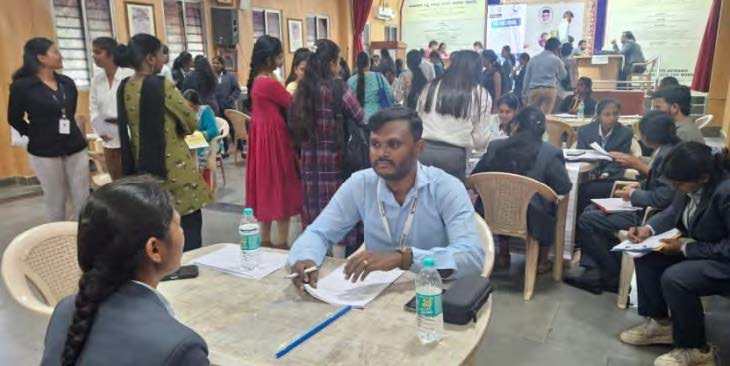
The Inclusive Mega JobFair 2026, held on February 21, 2026, at Maharani Lakshmi Ammanni College (mLAC), was a resounding success. Organized by mLAC, Rotary Club of Bangalore and Youth4Jobs.
the event brought together 64 companies and over 350 candidates, including 130 specially-abled individuals. Participating companies, such as Mitti Cafe, Wipro, Bluedart, Dr. Reddy’s Foundation, Quess D Mart, Nandana Palace, Saira Jobs, Flipkart and Myntra showcased their commitment to inclusive employment.
This exclusive job fair aimed to empower persons with disabilities, fostering economic self-reliance and a sense of belonging. By providing a platform for candidates to connect with potential employers, the event promoted diversity and inclusion in the workforce.
The job fair’s success is a testament to the growing recognition of the importance of inclusive employment. Initiatives like these pave the way for a more accessible and equitable work environment.
– Rtn Kalyani Talukdar
Humanity’s Journey Through Technology


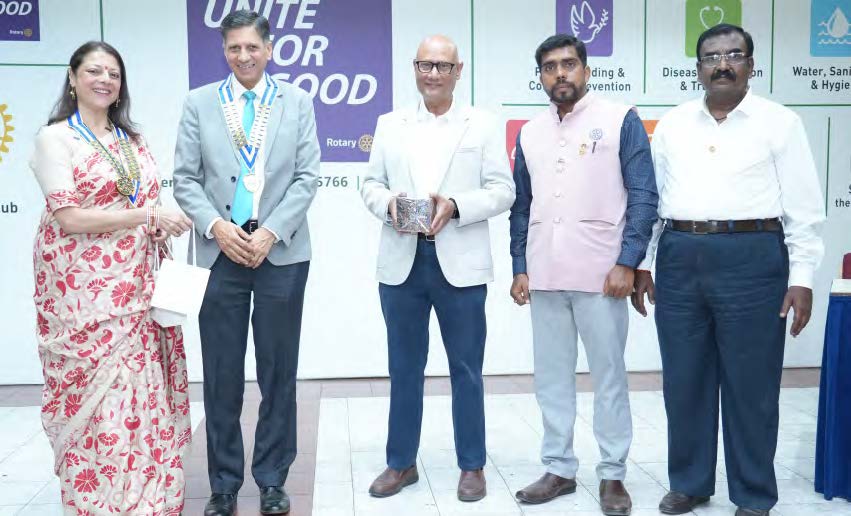
The march from the 1950s to the age of Generative Al has reshaped the way we move, think, and grow. Standing at the cusp of something tremendous, as seen through the lens of tech veteran Ram Mohan, this is not a rupture but a continuum.
Mr Ram Mohan while addressing Rotarians at RCB this Monday said in the mid-20th century, technology was still a promise more than a pervasive presence. The 1950s gave us the transistor, the television, and the early stirrings of computing, but life remained largely analog. People moved through the world with paper maps, wrote letters by hand, and relied on human memory and physical archives to store knowledge. Yet even then, the seeds of transformation were being sown. Each decade since has layered new capabilities on top of what came before, reshaping not just how humanity works, but how it thinks, grows, and even perceives itself.
By the 1970s and 80s, computing began to enter offices and laboratories, changing professional life in ways that were subtle but profound. The personal computer of the 1980s was more than a machine,it was a new cognitive partner, allowing individuals to calculate, design, and communicate with unprecedented speed. Humanity’s adaptive rate was already accelerating, building on the shoulders of earlier breakthroughs. Each innovation was not a replacement but a scaffold, enabling the next leap, he emphasised.
The 1990s brought the internet, and with it, a tectonic shift in how humanity moved and connected. Suddenly, geography was no longer a barrier to communication or commerce. The web became a resource hub, a vast library where knowledge was democratised and distributed.
Professional life was transformed as businesses globalised, and personal life was reshaped as friendships and communities began to thrive in digital spaces. The internet was not just a tool; it was an infrastructure, a new nervous system for society.
The mobile revolution of the 2000s pushed this infrastructure into our pockets. Movement itself changed: GPS navigation altered how we travelled, mobile banking redefined how we transacted, and social media reshaped how we expressed identity. Humanity’s rhythms became faster, more adaptive, and more dependent on digital scaffolding.
Then came Artificial Intelligence, first as a specialised tool in research and industry, and now as a mainstream presence.
Generative AI, once confined to resource hubs and experimental labs, has become infrastructure in its own right. It is no longer an accessory but a foundation woven into search engines, creative platforms, workplaces, and homes. The journey from mobile to internet to Al is not just chronological; it is evolutionary, he said. Each stage has accelerated humanity’s adaptive rate, and with Al, the acceleration feels exponential.
Mr. Ram Mohan, a veteran of the technology world, described this moment as a juncture of something tremendous. He has lived through the maze of shifting paradigms, watching as each wave of innovation redefined the professional landscape. His insight is that generative Al has not merely added convenience, it has pushed humanity toward cognitive dependency. Where once we relied on memory, then on search engines, now we lean on Al to think with us, to draft, to design, to decide. The dependency is not passive; it is active, shaping how we approach problems and how we imagine solutions.
This dependency raises profound questions about growth. Al is different. It does not just extend our hands; it extends our minds. It changes the way we think, the way we learn, and the way we create. In professional life, it accelerates productivity, but it also alters judgment, as decisions are increasingly mediated by algorithms. In personal life, it offers companionship, creativity, and guidance, but it also risks narrowing the space for independent thought.
Yet, as Ram Mohan emphasises, this is not a rupture but a continuum. Technology has always been cumulative, each generation building on the scaffolding of the last. The transistor enabled the computer, the computer enabled the internet, the internet enabled mobile, and mobile enabled Al. Humanity’s journey is one of layering, each layer deepening the way we move, think, and grow.
The story of technology from the 1950s to today is, in essence, the story of humanity learning to live with its own creations. It is a story of acceleration, of dependency, of possibility. It is a story where the tools we build reshape us in return, pushing us toward new forms of cognition and new ways of being. And as Ram Mohan reminds us, the maze of technology is not a trap, it is a path, winding and layered, leading us toward futures we are only beginning to imagine.
New Campaign: Swachatha Abhiyan in School
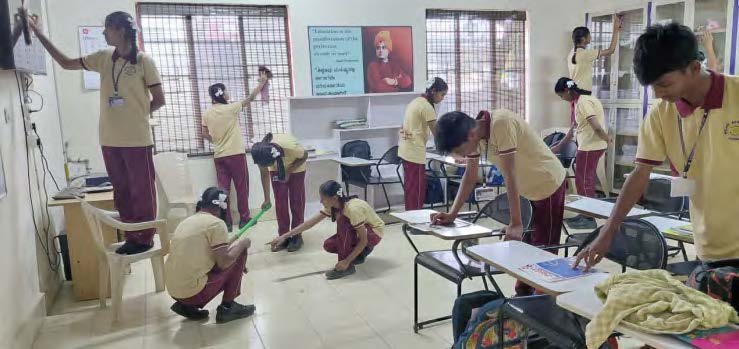
As part of our commitment to cleanliness and civic responsibility, we are launching Swachatha Abhiyan in School.
Before the school closes at 3:30 pm the first bell will ring at 3:25 pm, marking the start of a five-minute cleanliness drive. During this time, all students will work together to collect waste from classrooms and school premises and dispose of it in dustbins. They will also wipe classroom boards and clean their benches.
The final bell will ring at 3:30 pm, after which students will leave for home.
This simple daily practice will help instill discipline, responsibility, teamwork, and respect for a clean environment among students.
-Rtn Manju n Rtn Sapna Paul
New Campaign: Swachatha Abhiyan in School
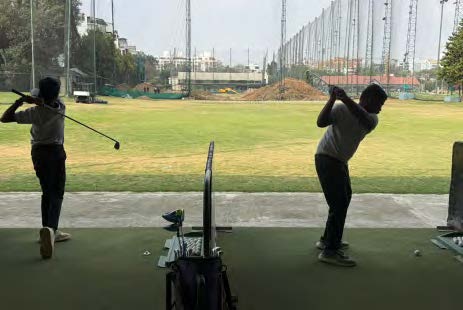
It has been three months since we launched the Rotary Bangalore Golf Academy at Begur Government School. Following a structured selection process from a pool of 150 students, 25 promising and talented boys and girls were shortlisted for the program.
Over the past three months, the selected students have been undergoing regular practice sessions at the school every day from 3:00 pm to 5:00 pm. Their dedication and enthusiasm have been truly encouraging.
We are grateful to Karnataka Golf Association (KGA) for generously allowing six students every Tuesday afternoon to practice at their facility.
The children get hands-on experience at the driving range, bunker, chipping fairway, and putting green. This exposure gives them the invaluable opportunity to experience playing on actual grass.
We are confident that with continued training and support, we will soon see them performing on the golf course with pride and excellence.
-Rtn Pravin Singhvi
