rotarycb1934@gmail.com
+91 80 2212 0317
Rotary House of Friendship 20, Lavelle road, Bengaluru
Happy reading!
Your Rotator Team 2025–26
Uniforms & Shoes Distribution at Rotary Bangalore Vidyalaya (RBV)
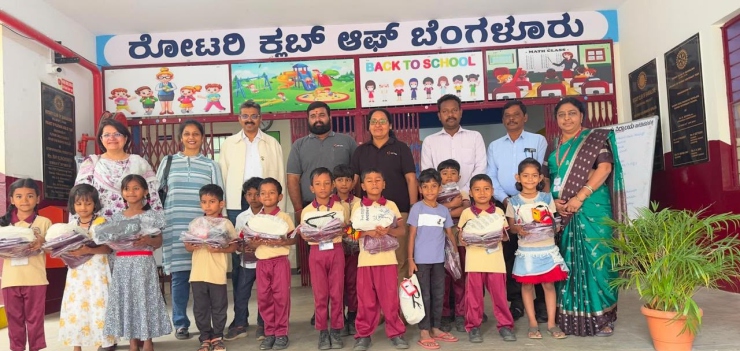
The Uniforms & Shoes Distribution programme was held at Rotary Bangalore Vidyalaya (RBV) on 18-07-2026, benefiting 450 students. The initiative was jointly sponsored by CIE Automotive India Ltd. and the Rotary Club of Bangalore, with CIE Automotive India Ltd. sponsoring the school uniforms and the Rotary Club of Bangalore sponsoring the shoes.
The distribution aimed to provide students with essential school attire, enabling them to attend school with greater confidence and dignity. The event was attended by Rtn. Dr. Anju Agadi, Rtn. Dr. Maneesh Paul (Director – Community Services), Rtn. Sapna Paul, and representatives from CIE Automotive India Ltd.
-Rtn. Sapna Paul
Educating the Tribals
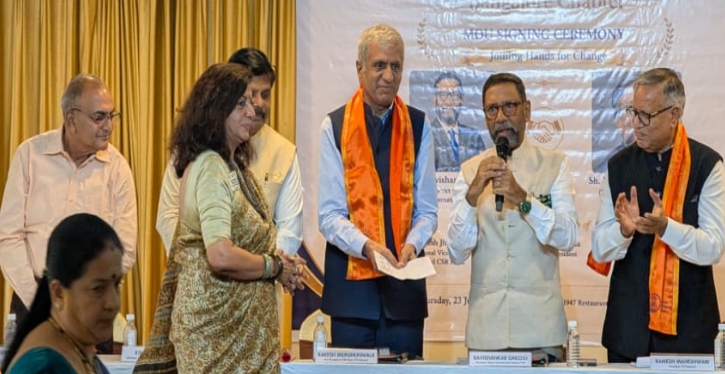
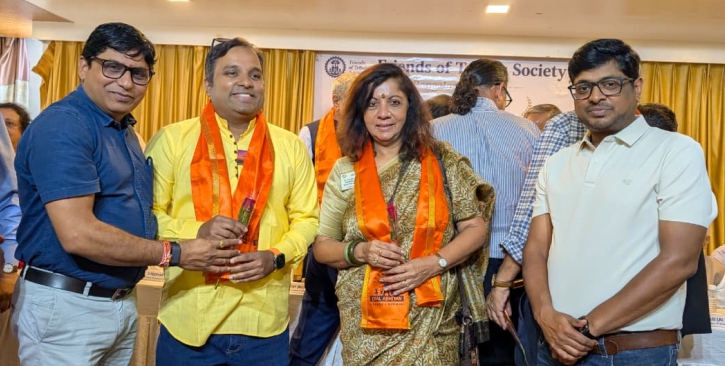
Rotary club of Bangalore as part of the Rotary International collaboration has funded 10 tribal school at the cost of Rs 3 lakhs.
This project was sponsored by DG Ravishankar Dakoju.
Growing Up Strong – Puberty, Growth and Healthy Habits for Teens
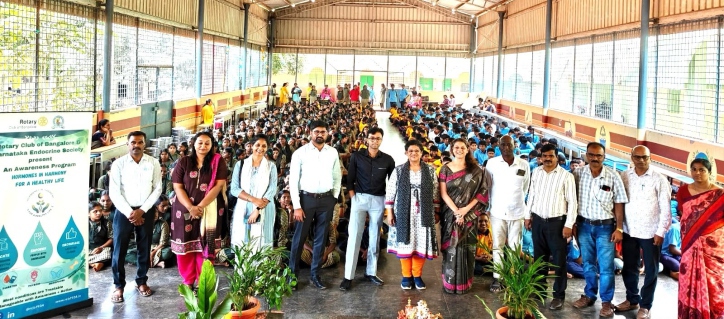
On 22 July 2026 the Rotary Club of Bangalore, with the Karnataka Endocrine Society, Subash Bagaria Foundation and Chilume Organization, held the 10th session of the Hormones in Harmony endocrine wellness series at Chikkabidarakallu Government High School, Bengaluru.
The Kannada session, “Growing Up Strong: Wellness Guide on Puberty, Growth and Healthy Lifestyle for Teens,” reached 444 students from Classes 8-10 and 16 teachers. Delivered without slides, the interactive format encouraged open, respectful discussion about adolescence, growth and wellbeing, with students asking thoughtful questions that highlighted the need for accurate, age-appropriate health education.
Key takeaways: Dr. Chethan Y. stressed balanced diet, regular exercise, adequate sleep and reduced screen time to prevent obesity and metabolic disorders; Dr. Gopinath N. explained the biological and emotional changes of puberty, outlined warning signs of abnormal development, and introduced age- and gender- specific growth charts, urging annual height and weight records to detect problems early.
Thanks to our partner organizations for their support. Attending Rotarians were Kavita Muthappa, Sapna Paul and Dr. Nita Roy.
– Rtn Dr. Nita Roy
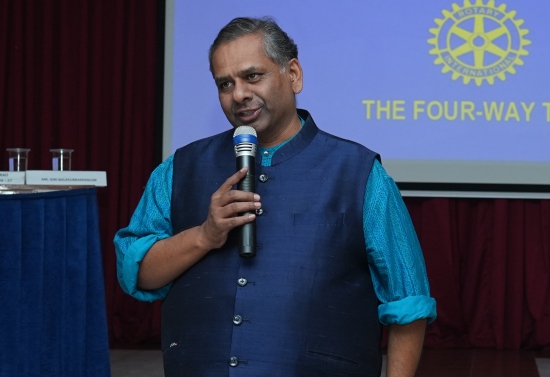
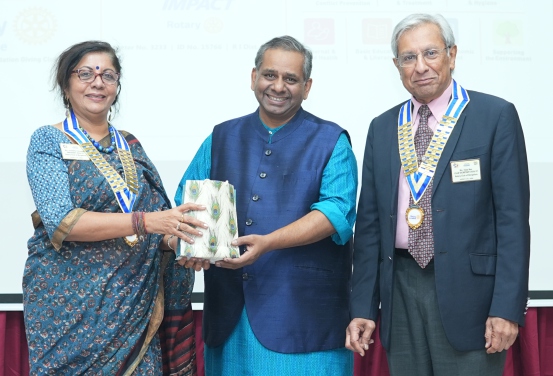
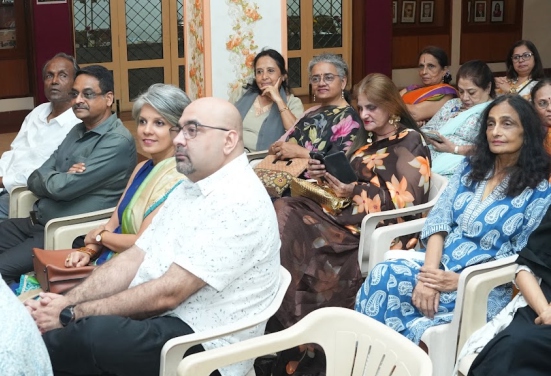
The Monday evening meeting of the Rotarians began like any other-formal introductions, polite exchanges, and the familiar rhythm of business as usual. Yet, this particular evening carried a spark. It was transformed into a quizzical journey by Quiz Master Giri Subramaniam, who challenged the audience not with routine trivia but with questions that probed the very essence of human curiosity. His master pitch was simple yet profound: Why do curious people live longer? What ignites curiosity?
Before the first question was posed, Giri laid the foundation with three pillars of thought. He drew from the wisdom of great leaders, Harvard University’s landmark study “What Makes a Good Life?”, and GREYCAPS’ research on the power of curiosity.
These references framed his argument: curiosity is not a frivolous trait but a force that shapes emotional wellbeing, strengthens social bonds, and fuels adaptability.
He explained that curiosity manifests in three critical dimensions. First, emotional wellbeing, which gives life meaning and resilience. Second, social interaction, where curiosity thrives in conversations, group dynamics, and community engagement-even in silence. Third, adaptiveness, the intellectual indulgence that
urges us to try, fail, and try again. “Let’s fail,” he said, “because failure is the first step to discovery.”
To illustrate the transformative power of curiosity, Giri invoked names that have altered the course of history: Mahatma Gandhi, Nelson Mandela, A.P.J. Abdul Kalam, and Jamshedji Tata. Each of them, he argued, was propelled by an insatiable curiosity-about justice, science, society, and enterprise. A single person, armed with curiosity, can indeed reshape nations.
Yet, he lamented the lack of curiosity among today’s youth. To overcome this, he urged the cultivation of community service and the courage to embrace failure.
“There is success in failure,” he reminded, urging the audience to teach the younger generation that curiosity is not just about asking questions but about daring to explore the unknown.
With this, the evening shifted gears into a pictorial quiz. His first poser was topical, tied to the recently concluded FIFA World Cup. The audience was shown a photograph and asked to identify the first documented Indian to own two football clubs decades ago. Silence filled the room. The answer was startling-Mahatma Gandhi. Gandhi had owned two clubs in South Africa, named Passive Resistance, using them as vehicles to teach the philosophy of nonviolent protest in a land where public gatherings were banned.
The questions that followed were equally intriguing. One explored retail psychology: how Apple introduced its first iPhone while already having advanced versions ready, yet deliberately released them in sequence to manipulate consumer desire for “the next version.” Another delved into the rare Himalayan Cordyceps, known locally as Yarsagumba or “Himalayan Gold,” a parasitic fungus prized in Tibetan and Chinese medicine for its energy-boosting properties.
A current affairs question left the audience guessing. Ten tiny islands were shown, representing a nation of just half a million people that had stunned the football world. The answer: Cape Verde, officially Cabo Verde, an archipelago off West Africa.
Their group-stage performance in the World Cup included a 0-0 draw against Spain, a 2-2 draw against Uruguay, and another stalemate against Saudi Arabia. For a nation so small, their achievement was monumental.
The quiz continued with more posers, each designed not merely to test knowledge but to ignite curiosity. The audience realised that the purpose was not about winning points but about awakening the mind to connections between history, science, commerce, and culture.
As the evening drew to a close, Giri returned to his central theme. Curiosity, he said, is immeasurable in its power. It is the spark that drives us to discover versions of ourselves we never knew existed. It connects us to society, aligns us with purpose, and strengthens our belief in community. To be curious is to be alive, resilient, and ever-evolving.
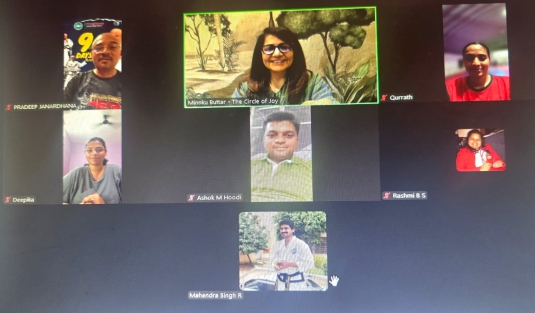
A virtual reinforcement meeting was conducted by Strong Her project lead Minnku Buttar, with the partners of Taekwondo team to once again to realign with the vision and purpose of the programme, and present the program in the coming year with a new specialised format.
It was re-emphasized that STRONG HER is not merely about helping the girls to understand the purpose behind every exercise and demonstration, connecting each technique to real-life situations where it can be used for protection and safe escape.
Minnku pressed upon the importance of maintaining the highest standards of professionalism, discipline, respect, and sensitivity while engaging with schoolgirls.
The meeting concluded with a shared commitment from the team to continue serving not just as Taekwondo instructors, but as mentors and role models who inspire confidence, self-belief, and personal safety in every girl they train.
Champion: Rtn. Minnku Buttar